
29May

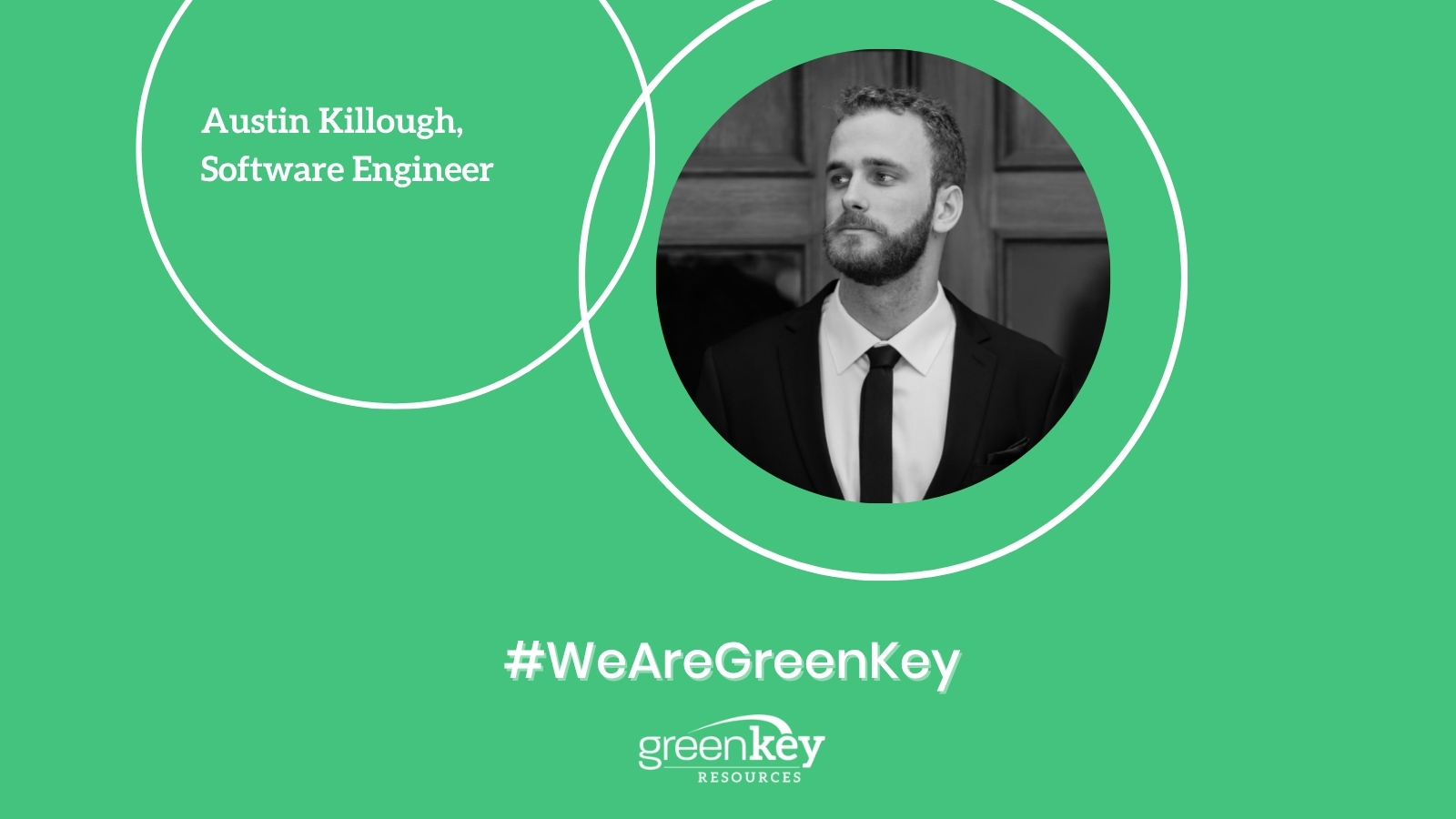
When Austin Killough joined Green Key’s IT team, he stepped into a role centered on innovation, problem-solving, and supporting the technology that powers day-to-day operations across the firm. With prior experience working with Green Key and a background in staffing technology, Austin saw a strong cultural and technical fit – along with the opportunity to make an immediate impact. 

“I had worked with Green Key in the past, so I already knew the culture was fast-moving and focused on getting things done,” he shared. “What stood out to me was the opportunity to work across more automation and data-driven initiatives within the IT team.” 

A Broad and Evolving Role Across Technology and Automation 

In his day-to-day work, Austin supports a wide range of systems and initiatives across the organization – from CRM development and data analysis to AI and automation tools that enhance recruiter workflows and business operations. 

“No two days look the same, which is something I really enjoy,” he explained. “Some days I’m rolling out new automation initiatives for business development; other days I’m preparing data from new vendors for reporting.” 

His work also includes recruiter-facing tools such as resume ingestion, candidate search and matching systems, and other workflow improvements designed to increase efficiency across teams. 

Staying Ahead in a Rapidly Changing Tech Landscape 

As technology continues to evolve, continuous learning plays a key role in Austin’s work. He credits Green Key’s culture with making it easy to stay current and explore new tools that can create meaningful business impact. 

“Green Key is very supportive of ongoing learning,” he said. “That can mean attending AI conferences, participating in paid trainings, experimenting with new tools, or having dedicated time to explore technologies that could benefit the business.” 

One of the ongoing challenges in his role is balancing speed with scalability in a fast-moving environment. 

“The biggest challenge is balancing long-term scalability with our ‘just do it’ mindset,” Austin shared. “We move quickly and aren’t afraid to test new ideas. Once we validate a concept, we shift into optimization mode so it’s ready for broader use.” 

Collaboration, Impact, and Building for the Business 

Collaboration is central to how the IT team operates at Green Key. Austin works closely with teams across the organization to ensure that the tools being built reflect real workflows and solve meaningful problems. 

“A big part of our success comes from understanding each team’s workflows, preferences, and pain points,” he explained. “That ensures we’re building solutions that genuinely help the people using them, not tools created in isolation.” 

That cross-functional work spans accounting automation, marketing support, leadership reporting, and recruiter productivity tools –  all aimed at improving efficiency and enabling better decision-making across the firm. 

For Austin, one of the most rewarding aspects of the role is the autonomy to experiment and continuously improve. 

“The most rewarding part has been the autonomy to grow and experiment,” he said. “Green Key doesn’t enforce a rigid ‘one right way’ to build things, which gives me the freedom to solve problems creatively and continually expand my skill set.” 

Why Green Key 

For Austin, Green Key represents an environment where innovation and impact go hand in hand. The ability to build, test, and refine solutions in real time allows him to see the direct impact of his work across the organization. 

“It’s motivating to know we’re building tools that directly improve how people work every day,” he shared. “The ability to experiment, improve processes, and see real impact across the business makes this a really rewarding place to be.” 

Austin’s work highlights the innovation and expertise that exist across Green Key’s IT team and beyond. If you’re interested in joining a team that’s leveraging technology, data, and automation to drive continuous improvement across the firm, visit our website to explore open opportunities and learn more.  

You can view current openings and learn more about joining Green Key here. 

Anthropic Unveils Claude 3: Redefining AI Chatbots with Enhanced Capabilities

Anthropic, the AI startup backed by Google and with substantial venture capital, has just introduced the latest iteration of its GenAI technology: Claude 3. This announcement marks a significant advancement in AI capabilities, positioning Claude 3 as a formidable competitor even against OpenAI’s GPT-4.

Advanced Capabilities

According TechCrunch, “Claude 3, as Anthropic’s new GenAI is called, is a family of models — Claude 3 Haiku, Claude 3 Sonnet, and Claude 3 Opus, Opus being the most powerful. All show “increased capabilities” in analysis and forecasting, Anthropic claims, as well as enhanced performance on specific benchmarks versus models like ChatGPT and GPT-4 (but not GPT-4 Turbo) and Google’s Gemini 1.0 Ultra (but not Gemini 1.5 Pro).”

Multimodal Functionality

One notable feature of Claude 3 is its multimodal functionality, enabling it to analyze both text and images. This capability, like some iterations of GPT-4 and Gemini, allows Claude 3 to process various visual data such as, “…photos, charts, graphs and technical diagrams, drawing from PDFs, slideshows and other document types.” TechCrunch went further to note, “In a step one better than some GenAI rivals, Claude 3 can analyze multiple images in a single request (up to a maximum of 20). This allows it to compare and contrast images, notes Anthropic.” However, Anthropic has imposed limits on image processing to address ethical concerns, “Anthropic has disabled the models from identifying people…”

Claude 3’s Limitations

While Claude 3 showcases remarkable advancements, it’s not without limitations. TechCrunch reported that, “…the company admits that Claude 3 is prone to making mistakes with “low-quality” images (under 200 pixels) and struggles with tasks involving spatial reasoning (e.g. reading an analog clock face) and object counting (Claude 3 can’t give exact counts of objects in images).” Anthropic promises frequent updates to Claude 3, aiming to enhance its capabilities and address existing limitations. These updates will include improvements in following multi-step instructions, structured output generation, and multilingual support, making Claude 3 more responsive and adaptable to user needs.

As Anthropic continues to innovate and expand their offerings, the company remains dedicated to fostering a transparent and responsible approach to AI development. With substantial backing and a clear roadmap for future enhancements, Anthropic is poised to share the future of AI-driven solutions and pave the way for transformative advancements in various domains.

If you’re looking to take your career to the next level be sure to check out our IT page.

Businesses Are Seeing The Value of Blockchain Sample

Now organizations in sectors well beyond the pioneers in finance are investing in blockchain to protect data, decentralize processes and facilitate asset and data transfer.

“It’s an appealing model for many sectors, promising transparency and trust as it helps make value exchange possible,” says a SmartBrief article. Although focusing mostly on the financial sector, which is where blockchain found its earliest uses, the article mentions the steady creep of the technology into other industries and even slowly becoming commoditized as “blockchain as a service.”

“Amazon and Microsoft both currently offer BaaS, and enterprises as well as startups are taking advantage of it,” says SmartBrief. Citing a Gartner survey of CIOs, the article notes that “60% expected their firms to start or continue adopting blockchain-based technology between now and 2023.”

Earlier this year, Deloitte issued a blockchain trends report. Besides describing the evolving technology and the features each different approach offers, Deloitte found that some of the fastest growth in blockchain investments was coming in such unexpected industries as professional services – a sector that includes the staffing and employment industry – and energy and resources. In each of those 38% and 43% respectively of the firms surveyed were spending at least $5 million each on blockchain initiatives.

Not unexpectedly, the largest percentage of businesses investing in blockchain were in technology, media and telecom.

“More organizations in more sectors — such as technology, media, telecommunications, life sciences, health care, and government — are expanding and diversifying their blockchain initiatives,” Deloitte observes.

Like the financial sector, life sciences and health care deal with highly sensitive medical data they must protect or face legal consequences. Those two sectors are where blockchain “can have a more immediate and meaningful impact,” says Deloitte. They are in an industry, the report explains, “In which data transparency, speed of access, immutability, traceability, and trustworthiness can provide the information necessary for life-altering decisions.”

Interestingly, Gartner assigns a similar importance – not life or death, but still vital – to blockchain’s value to media.

“Organizations and governments are now turning to technology to help counter fake news, for example, by using blockchain technology to authenticate news photographs and video, as the technology creates an immutable and shared record of content that ideally is viewable to consumers,” Gartner said.

[bdp_post_carousel]